
The day my sister set me up began with my mother sliding a wire transfer form across the breakfast table and telling me I had one last chance to “do the right thing.” My name, Claire Bennett, was already filled in on the sender line. Madison’s name appeared on the receiver line. The amount was $400,000. “That money is just sitting there,” my father said. “Madison needs it now.” My sister sat across from me, perfectly composed, as if I were the selfish one for refusing to fund her idea. She wanted six months in Europe to launch a luxury travel brand. I called it what it really was: a lavish vacation disguised as a business plan. “No,” I said. “I worked for that money. I’m not giving it away.” Madison’s eyes hardened. “You always act like you’re better than me.” I was twenty-nine. She was thirty-three. Every dollar in that account came from eight years of work and from selling my share in a home-staging company I had helped build. Madison had burned through jobs, credit cards, and our parents’ patience, yet somehow I was still the villain because I wouldn’t rescue her again. I left before the argument could get worse. The following morning, I was loading
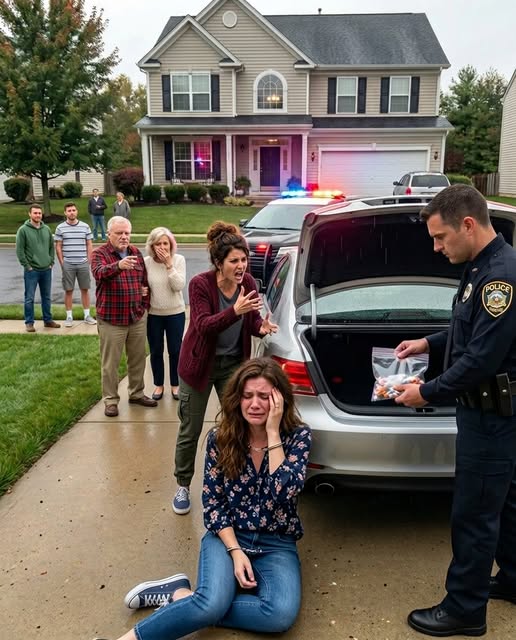
That night they came to see me.
My father leaned forward across the metal table. “If you transfer the $400,000 to us tonight, we can still control this.”
I stared at him, too stunned to speak.
My mother kept her tone gentle. “Otherwise, Claire, this could ruin your life. Prison is not impossible.”
It was blackmail—clean, calculated blackmail.
I refused to sign anything.
The next morning I met the lawyer they had supposedly arranged for me, Nina Alvarez. I expected her to pressure me into accepting a plea. Instead, she listened carefully while I explained that Madison had planted the drugs and my parents had backed her up.
Then she asked one question.
“Does your car have a dashcam with parking mode?”
My pulse jumped. “Yes.”
For the first time her expression changed. “Good,” she said. “Because if that camera recorded who opened your trunk, your sister didn’t just frame you. She gave us the evidence to destroy her.”
Nina moved faster than anyone I had ever seen. Within an hour she had contacted the towing company, requested the dashcam unit from my impounded car, and sent an investigator to my townhouse complex to secure security footage before it could be erased. For the first time since my arrest, I felt something close to hope.
While we waited, Nina asked precise questions. Who could access my car? Did Madison know where I kept the spare key? Had she been at my townhouse recently?
The answers came too easily.
Madison had borrowed my car twice that month. She knew the spare key was hidden in a planter beside my front door because my mother had pointed it out once. And yes, Madison had come by the night before my arrest, furious after I refused the transfer.
Late that afternoon, Nina returned carrying a hard drive and a look that made it difficult to breathe.
“The camera worked,” she said.
She turned her laptop toward me. The footage was grainy but unmistakable. At 11:42 p.m., my porch light turned on. Madison appeared wearing a baseball cap and my father’s rain jacket. She used the spare key, opened my car, lifted the trunk, and placed something inside the emergency kit. Then she shut the trunk and walked away as if nothing had happened.
I felt both sick and relieved at once.
“There’s more,” Nina said.
The complex security camera showed my parents’ SUV parked across the street with my mother in the passenger seat. They hadn’t simply believed Madison.
They had driven her there.
Nina immediately called the prosecutor and demanded an emergency meeting. She also reviewed my recent messages. Buried in an old family group chat was a sentence that tied motive to pressure. My father had written, “If Claire won’t help Madison willingly, we may have to force her to understand what family means.”
At the time I had ignored it.
Now it looked like a threat.
The prosecutor agreed to a pre-charge meeting the next morning. My parents and Madison were told it was an opportunity to clear up inconsistencies before the case proceeded. They arrived looking confident. My mother wore pearls. My father carried a folder. Madison looked irritated more than worried.
Nina said almost nothing.
She opened the laptop and pressed play.
No one moved during the video.
Madison watched herself unlock my car and hide the pills. My mother’s face went pale halfway through. My father leaned forward so sharply his chair creaked. When the second clip showed their SUV parked across the street, Madison cracked first.
“It was supposed to scare her,” she said. “Not turn into this.”
The prosecutor’s voice stayed calm. “Scare her into what?”
Silence.
Nina answered by sliding the transfer form across the table.
“Into signing over $400,000.”
My mother snapped, “You have no idea what pressure this family has been under.”
I looked at her and said quietly, “You mean the pressure of not getting my money?”
My father finally dropped the act. “You had more than enough,” he said. “Madison needed help. You could have fixed this with one signature.”
When I stood in court, my voice stayed steady. I said I had spent my entire life being treated as the backup child—the reliable one, the one expected to absorb damage quietly because someone else always mattered more. I said the worst thing they had taken from me wasn’t sleep, money, or dignity.
It was my belief that home meant safety.
The courtroom stayed silent after that.
The judge sentenced Madison to four years, with eligibility for parole after two. My parents each received county jail time, probation, and financial penalties. Some people later told me the punishment seemed harsh. Those people had never sat in a holding cell because their own mother lied without hesitation.
Two months later I sold the townhouse and moved into a Craftsman house. Nina helped connect me with a financial adviser, and for the first time I structured my savings so no relative could ever reach them. I changed my locks, changed my phone number, and replaced the emergency contact on every account I had.
Boundaries, I learned, aren’t cruelty.
They’re survival—with paperwork.
Life didn’t suddenly become easy after that, but it became honest. I slept again. I returned to consulting work and reduced my client load so I could breathe. I started volunteering weekly with a legal aid group that helps women facing fraud, coercion, and financial abuse.
About seven months later, I received a letter from Madison in prison. I recognized her handwriting instantly. I left it unopened in a kitchen drawer for three days before shredding it. I didn’t owe curiosity to the person who tried to trade my freedom for a transfer form.
Sometimes I still think about that morning—the police lights, the trunk, and the way my father said prison like it was a negotiation tactic.
Then I look around my quiet house and remember something better.
They were willing to destroy me for access to my future.
And they still failed.
If my story moved you, share your thoughts below. And tell me honestly—would you ever forgive family after something like that?