
Part 1: The Locked Nursery: The highway to the private airport stretched endlessly beneath my headlights while my phone rested beside me on the console. Until that afternoon, I truly believed wealth could shield the people I loved from the kinds of nightmares that only happened inside other families. I had built my entire life around preparation, security, and control. Expensive homes. Private staff. Legal protections. Carefully structured routines. I convinced myself that enough money and enough planning could keep disaster outside my walls. I was driving toward Napa Valley to secretly finalize the purchase of a vineyard resort I planned to surprise Vanessa with before our wedding. The property was supposed to become our wedding retreat, a grand romantic gesture built from gratitude and optimism. I remember thinking, just before the alert arrived, that my life finally looked stable. Then my phone vibrated. A motion notification from the hidden hallway camera appeared on the screen. Officially, I had installed the cameras for security reasons. Unofficially, I installed them because my triplets had recently started behaving in ways I
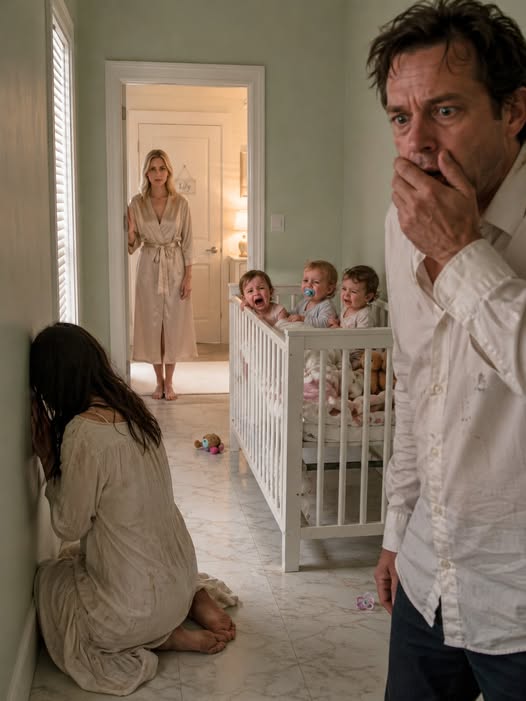
“Be quiet, or you won’t eat tonight.”
For one horrible second, my brain tried to reinterpret the sentence into something harmless. A joke. A misunderstanding. Anything except what it clearly was. Then she repeated it more slowly, colder this time, with absolute seriousness.
I slammed on the brakes so hard the SUV behind me nearly crashed into my car. Horns exploded around me while I whipped into a dangerous U-turn across traffic. I barely remember the drive home after that. I only remember gripping the steering wheel hard enough to hurt my hands while repeatedly calling Vanessa.
She never answered.
I called Rosa.
Nothing.
I called the house line.
Silence.
That silence terrified me more than panic because panic still leaves room for hope. Silence is where certainty quietly begins preparing itself.
When I finally reached the house, my hands shook so badly I entered the security code incorrectly twice. The keypad beeped sharply while my pulse hammered against my skull. I sprinted through the lobby screaming my children’s names while my voice echoed across marble floors and expensive glass walls that suddenly felt meaningless.
Upstairs, I found the nursery door locked from the outside.
Not jammed.
Not stuck.
Locked.
I slammed my shoulder into it once. Then again. When it still didn’t open, I kicked beside the handle until the frame cracked and the entire door burst inward.
The boys huddled together on the carpet crying hysterically, faces soaked with tears and red from panic. But they weren’t the worst thing inside that room.
Rosa lay beside the crib with her wrists tied behind her back using a phone charger. One side of her face was bruised badly, and blood ran from her split lip onto the nursery rug. She looked at me with the expression of someone trying desperately not to lose consciousness.
For several seconds the room fractured into separate nightmares, and my brain couldn’t decide which horror to process first.
Then all three boys screamed “Daddy!” simultaneously, and instinct took over before thought could catch up.
I dropped to my knees and pulled them against me one by one. I checked foreheads, wrists, breathing, eyes, anything I could think of while they clung to my shirt like terrified survivors. Noah was burning hot from crying so hard. Mason had red pressure marks around one wrist. Eli shook so violently his teeth rattled together.
“Daddy came,” Noah sobbed against my shoulder with overwhelming relief, like he genuinely wasn’t sure I would.
That sentence permanently damaged something inside me.
No child should sound surprised that rescue arrived.
I kept whispering desperate promises while holding them. I told them they were safe now. I told them nobody would ever hurt them again. Parents say those things automatically during emergencies even before they know whether safety truly exists anymore.
Once the boys calmed enough to stay together beside the crib, I crawled toward Rosa and untangled the charger from around her wrists. Her hands trembled violently while she tried speaking through tears.
“She locked us in,” Rosa whispered. “When I tried to stop her, she hit me.”
Rage flooded through me so intensely it almost became dizziness. I could physically feel my heartbeat inside my throat.
Then Rosa looked toward the hallway nervously.
“Ethan… she wasn’t alone.”
The sentence hit harder than I expected because my mind had already filled the house completely with Vanessa’s betrayal. I had no emotional space prepared for something even worse.
“What do you mean she wasn’t alone?” I asked.
Rosa swallowed hard before answering.
“She was downstairs talking to a man. I heard her say, ‘They’ll calm down eventually. Ethan won’t be back for hours.’”
The nursery suddenly felt colder. Not physically. Psychologically. The entire house seemed to widen around me, making room for a larger horror than I originally imagined.
“Did you see him?”
Rosa nodded weakly.
“Tall. Dark beard. Gray jacket.”
Recognition hit instantly.
Three weeks earlier, Vanessa introduced me to an old “friend” named Adrian Wolfe during a charity gala in Denver. At the time I dismissed my discomfort as jealousy or exhaustion, but now every interaction replayed differently inside my head. The way he held my handshake too long. The way he watched my children with unsettling interest. The strange smiles Vanessa exchanged with him whenever she thought I wasn’t paying attention.
I grabbed my phone and dialed 911 while Rosa gathered the boys closer against her.
“My fiancée locked my children in the nursery and assaulted our nanny,” I told the dispatcher. “There may be another man inside the house. Send police and paramedics immediately.”
The operator asked whether the suspects were still inside.
That question made me realize I had never checked the rest of the house.
“I don’t know,” I admitted.
“Stay where you are until officers arrive.”
But parents do not think logically during situations like that. Every instinct inside me screamed that remaining still was another form of abandonment. I looked at my sons, then at Rosa, then toward the dark hallway beyond the shattered nursery door.
That was when Rosa grabbed my arm again.
“There’s more.”
I honestly believed I had already reached the emotional limit of what one human being could absorb inside a child’s bedroom.
I was wrong.
Before Vanessa dragged Rosa upstairs, she heard another voice coming from the guest room at the end of the hallway. A woman’s voice. Weak. Barely audible. Asking for water.
Not television audio.
Not a recording.
A real woman hidden somewhere inside my house while my children screamed behind locked doors.
I forced myself to stay focused by mentally counting what mattered. Three children alive. Rosa conscious. Police coming. Unknown male suspect. Unknown female victim. Vanessa somewhere nearby.
I handed Rosa my phone and told her to lock the nursery door after I left. I instructed her to shove the dresser against it and open it only for me or the police. She looked horrified watching me step toward the hallway, and honestly, I felt terrified too.
But the existence of that voice made standing still impossible.
I grabbed a heavy brass lamp from the dresser as a weapon, kissed each of my boys on the forehead, and promised I’d return before they finished counting to ten.
That was a lie.
Every promise made during a crisis contains desperation instead of certainty, but children need the shape of confidence even when adults can only offer movement.
The hallway outside the nursery felt strangely cold despite the heating system running through the house. The guest room door sat closed at the end of the corridor.
Then I heard it again.
A cough.
Weak.
Dry.
Desperate.
I pushed the door open slowly and saw a figure lying beneath blankets on the bed. At first I thought the woman might already be unconscious. Then she moved, and bathroom light illuminated bruises climbing her throat along with tape wrapped around one ankle.
Recognition hit me seconds later.
Tessa.
Vanessa’s younger sister.
Nine months earlier, Vanessa told everyone Tessa suffered a breakdown and voluntarily disappeared to Oregon for rehabilitation. Nobody questioned the explanation because wealthy families always know how to package ugly truths into respectable stories.
Now Tessa sat trembling in my guest room wearing one of Vanessa’s sweatshirts and staring at me like rescue itself felt impossible to trust.
“Water,” she whispered.
I rushed into the bathroom, filled a cup, and helped her drink while my understanding of Vanessa transformed into something far darker than cruelty.
Tessa suddenly grabbed my wrist with surprising strength.
“You have to get the boys out,” she whispered hoarsely. “They’re bringing paperwork tonight.”
“What paperwork?”
Her eyes darted fearfully toward the hallway.
“Guardianship documents. Medical forms. Adrian said if the children looked traumatized and Rosa disappeared, they could claim you became violent and unstable.”
The room physically seemed to shrink around me.
Vanessa wasn’t simply abusive.
She was building a system designed to erase me completely. Forged psychiatric claims. Emergency guardianship filings. Manufactured evidence using my terrified children.
“How long have you been here?” I asked quietly.
Tessa stared down at the blanket.
“I don’t know anymore. Weeks maybe. She keeps taking my phone. Locks the door. Says nobody would believe me anyway.”
Something inside me changed permanently at that moment. Fear hardened into a cold, terrifying clarity.
Then I heard the front door downstairs open.
Footsteps.
Two sets.
Vanessa had come home.
And Adrian was with her.
Part 2: The Plan to Erase Me
For one suspended second, the entire house froze around me. Tessa sat trembling on the bed, terrified to even breathe too loudly, while downstairs I heard Vanessa and Adrian entering the house together. Their footsteps echoed through the marble lobby with calm familiarity, like they still believed the night belonged entirely to them.
I moved before panic could slow me down.
Using bathroom scissors, I cut the tape from Tessa’s ankle and helped her stand. She nearly collapsed immediately, her body weak from confinement and exhaustion. The hallway outside the guest room was no longer safe. Voices were already moving toward the staircase.
Vanessa sounded irritated rather than frightened.
“He never checks anything without me,” she said sharply. “We still have time.”
Adrian replied with cold impatience.
“Then move faster.”
Part2: I canceled my private trip after a hidden camera captured my triplets screaming from behind a locked room. Outside the door, my fiancée calmly whispered “Be quiet, or you won’t eat tonight …” I nearly crashed making a U-turn back home. But when I finally broke that door open, my boys WEREN’T THE ONLY PRISONERS inside the house … and THE TRUTH waiting UPSTAIRS …
Not fear.
Not regret.
Frustration.
Like I had ruined an appointment rather than interrupted a criminal conspiracy involving my children.
I forced myself to stay calm enough to think clearly.
“My sons were locked in a room,” I said evenly. “Rosa was tied up. Your sister is trapped inside that bathroom. Start explaining.”
Adrian glanced sharply toward Vanessa with visible irritation before shifting his weight toward me like a man preparing for violence. Vanessa lifted one hand slightly, silently stopping him.
“There’s no point pretending anymore,” she said.
The complete emotional emptiness in her voice nearly frightened me more than the nursery footage.
“You never listened when I used words, Ethan. So I built something you would finally be forced to notice.”
“Built what?”
She smiled slightly.
Not kindly.
Proudly.
“Your entire life runs through systems,” she explained. “Timelines. Evaluations. Legal structures. Risk management. I simply created one strong enough to control you.”
A siren wailed somewhere in the distance outside.
Then another.
Vanessa heard them too, and for the first time that night something genuinely human cracked across her expression.
Adrian cursed under his breath and lunged toward me.
I reacted instinctively, throwing the brass lamp directly into his shoulder with enough force to send him crashing sideways into the dresser. Framed photographs shattered across the floor while he slammed against the bed frame with a roar of genuine pain and fury.
Then he came at me again.
The fight itself was ugly and clumsy because panic destroys technique. We collided hard enough to knock furniture sideways while punches landed wildly against ribs, shoulders, and jaws. Somewhere during the chaos I saw Vanessa sprinting toward the bathroom door.
Not away from danger.
Toward Tessa.
That told me everything I still needed to know about who she really was underneath all the elegance and manipulation. Even with police approaching, even with the entire plan collapsing, her instinct remained focused on controlling the witness.
I grabbed Vanessa around the waist before she reached the bathroom handle and yanked her backward. For the first time all night, she truly lost composure.
“You ruined everything!” she screamed directly into my face.
Adrian struck me from behind hard enough to drive me onto one knee. My mouth instantly filled with the metallic taste of blood while the brass lamp crashed across the floor nearby.
Then the guest room exploded with movement.
Daniel Mercer entered first wearing tactical black alongside two members of my security team. Behind them came uniformed officers flooding the hallway with shouted commands and flashing lights.
The entire atmosphere shifted instantly.
Predators always look less powerful once witnesses arrive.
Adrian tried fighting anyway. Daniel and one of the guards slammed him against the wall before he fully processed how badly the situation had changed. Vanessa reacted even worse. She screamed accusations at everyone simultaneously while struggling violently against the officers.
“He attacked me!”
“She’s unstable!”
“They’re kidnapping the children!”
Liars who survive through control rarely become honest once collapse begins. They simply become louder.
Even while officers forced her onto the carpet in handcuffs, Vanessa continued screaming that everything happening inside the house was somehow my fault. Adrian shouted legal threats while blood ran from the corner of his mouth. Tessa cried quietly inside the bathroom while paramedics rushed upstairs toward the nursery.
And from down the hallway came the sound that shattered me most.
My boys crying again.
Children sense violence through walls long before they understand the words adults use to explain it.
I pushed past officers and ran back toward the nursery. Rosa had followed my instructions exactly. The dresser blocked most of the broken doorway while she sat on the floor with the triplets wrapped tightly beneath blankets around her.
Despite her bruised face and split lip, she had spent the entire time telling them stories to keep them calm.
When Noah saw me enter, he burst into tears so hard he nearly choked.
“Daddy came back!”
That sentence will stay with me forever because no child should sound relieved that rescue returned after leaving the room.
The following hours unfolded in fragments that still feel disconnected in my memory. Paramedics checking temperatures. Police photographing injuries. Detectives moving through the house while evidence bags filled every room. Tessa wrapped in blankets downstairs crying silently while giving statements between panic attacks.
At some point, a detective named Maren Bishop sat me inside the living room and began asking questions while red and blue lights flashed across the windows.
I told her everything.
The hidden cameras.
The nursery footage.
Rosa tied to the floor.
Tessa locked upstairs.
Adrian.
The guardianship paperwork.
The moment I mentioned forged legal documents and psychiatric claims, Bishop’s entire expression sharpened instantly.
“What exactly did Tessa tell you about the paperwork?”
I repeated every detail carefully.
Temporary guardianship requests.
Medical instability forms.
Fabricated reports describing violent behavior.
The detective exchanged a long look with another officer standing nearby.
That was when I realized the nightmare was even bigger than child abuse or kidnapping.
Vanessa and Adrian were building a legal structure designed to erase me completely.
Adrian Wolfe wasn’t simply an old friend from a charity gala. He was a disbarred attorney previously investigated for coercive guardianship fraud involving wealthy families. He specialized in manipulating legal systems during domestic crises. According to investigators later, Vanessa met him eighteen months earlier at a luxury leadership retreat in Scottsdale.
By then she already understood exactly what she wanted from me.
Not marriage.
Control.
My company was the prize.
The children were leverage.
Tessa eventually explained the rest during questioning.
Months earlier, she accidentally discovered draft guardianship paperwork open on Vanessa’s laptop. When she confronted her sister, Vanessa pretended everything was a misunderstanding. Two days later, Tessa disappeared.
Officially, the family claimed she relapsed emotionally and voluntarily entered rehabilitation somewhere in Oregon.
In reality, Vanessa locked her inside my guest room.
People accepted the lie because polished liars are often more believable than frightened victims. Respectable families survive by packaging cruelty into elegant explanations.
Police recovered Adrian’s briefcase from the hallway downstairs. Inside were completed guardianship filings, forged copies of my signature, fabricated psychiatric evaluations, and emergency corporate transfer documents tied directly to my company holdings.
The plan itself was horrifyingly sophisticated.
Terrify the children until they appeared emotionally unstable.
Restrain Rosa and frame her as dangerous or delusional.
Keep Tessa hidden until she could be relocated again.
Provoke me into a violent confrontation if necessary.
Then use pre-prepared legal filings and falsified psychological reports to portray me as an unstable father suffering some kind of breakdown.
Vanessa studied me long enough to understand exactly how institutional systems operate. Courts trust paperwork. Investors trust signatures. Authorities trust prepared narratives.
Had I arrived an hour later, I honestly don’t know how much further they would have gone.
That realization nearly destroyed me more than the nursery footage itself.
By morning the story had already begun leaking into local media. Once my company became connected to forged succession documents and attempted coercive guardianship transfers, national business outlets started covering it too.
Investors called nonstop.
Board members panicked.
My public relations team begged me for a statement.
I turned my phone off completely and sat beside three hospital beds instead.
That was the only collapse I cared about.
Mason whimpered in his sleep every few minutes. Noah clutched a stuffed dinosaur so tightly his knuckles turned pale. Eli refused to let go of my sleeve even while sleeping.
Everything else in my life suddenly looked microscopic beside those hospital beds.
Before leaving the hospital for treatment, Rosa grabbed my hand gently and whispered something that hurt worse than accusation ever could.
“I kept telling myself I was overthinking things because I needed this job.”
Part3: I canceled my private trip after a hidden camera captured my triplets screaming from behind a locked room. Outside the door, my fiancée calmly whispered “Be quiet, or you won’t eat tonight …” I nearly crashed making a U-turn back home. But when I finally broke that door open, my boys WEREN’T THE ONLY PRISONERS inside the house … and THE TRUTH waiting UPSTAIRS
Mason explained that food became “a reward for being easy.”
Eli said Aunt Tessa lived in “the sad room” because Vanessa believed it was “where bad people learn.”
There is no dramatic response to statements like that.
Only silence.
Only paperwork.
Only exhausted adults trying to translate unbearable truths into legal language strong enough to stop monsters permanently.
Part 3: The Camera That Saved Them
The criminal trial began almost a year after the night I turned the car around. By then the story had spread far beyond our city. National media framed it as a shocking case involving wealth, forged guardianship documents, and child abuse hidden inside a luxury home. But every headline still felt too clean compared to reality.
Real horror is rarely dramatic while it’s happening.
Most of the time it hides inside ordinary routines, polite conversations, and people convincing themselves they are probably overreacting.
Vanessa entered the courtroom wearing ivory-colored designer clothing, calm and perfectly styled as if appearances alone could still manipulate reality. Even after everything uncovered inside that house, she continued behaving like the victim of some misunderstanding rather than the architect of deliberate cruelty.
Adrian looked very different without expensive suits and carefully rehearsed charm. Prison had already stripped away the polished confidence he once used to move through wealthy social circles like a parasite searching for new hosts.
The prosecution spent weeks laying out the full structure of what they built together.
False imprisonment.
Child endangerment.
Assault.
Kidnapping.
Forgery.
Coercive financial fraud.
Conspiracy.
The courtroom grew especially quiet whenever prosecutors described the children. Jurors handled those moments differently than financial crimes or legal deception. Money creates anger. Harm toward children creates something heavier.
Then the prosecutor played the nursery footage.
The screen showed my three boys pounding against the locked door while crying hysterically. Vanessa stood outside wearing a silk robe, composed and patient. She leaned toward the door slightly before whispering the sentence that destroyed every illusion I still carried about her.
“Be quiet, or you won’t eat tonight.”
The courtroom atmosphere changed instantly afterward.
Not because the words themselves sounded especially violent.
Because they sounded intimate.
Whispered cruelty unsettles people more than screaming rage because it reveals comfort. It reveals practice. Monsters who whisper are monsters who feel completely safe.
I testified over two exhausting days. Prosecutors asked about the hidden camera, the drive home, what I found inside the nursery, and the moment I discovered Tessa locked upstairs.
I answered everything carefully because rage makes people emotional, but precision destroys liars more effectively than anger ever will.
The defense attempted turning me into the villain almost immediately. Their attorneys painted me as a paranoid billionaire obsessed with control, a man so suspicious he secretly monitored his own household. They claimed Vanessa merely enforced discipline while I interpreted ordinary parenting through the lens of stress and emotional instability.
Then one attorney asked the question that hit hardest.
“If you trusted your fiancée, Mr. Cole, why install hidden cameras at all?”
The courtroom went completely silent.
The truthful answer felt ugly, but I gave it anyway.
“Because part of me already knew my children were afraid of her,” I said quietly. “And instead of confronting the truth directly, I chose surveillance because I hoped I was wrong.”
That sentence changed the room.
Not because it excused me.
Because it exposed something painfully human.
Most people do not ignore warning signs because they enjoy denial. They ignore them because accepting the truth would force their entire life to reorganize itself around something terrifying.
After that moment, the defense lost momentum completely.
Evidence overwhelmed everything else. Rosa’s injuries. Tessa’s captivity. The forged documents recovered from Adrian’s briefcase. Financial records. Psychiatric forms prepared in advance. Audio recordings. Security footage.
And worst of all, the boys’ interviews.
Children describe trauma differently than adults. They don’t organize pain into legal terminology or psychological language. They explain it through routines and emotional associations.
Noah said Vanessa smiled more when they cried.
Mason described food as something you earned by “being easy.”
Eli explained that the guest room was “where sad people stayed until they learned.”
Those statements stayed inside the courtroom long after the interviews ended.
Vanessa was eventually convicted on the most serious charges alongside Adrian. Watching the verdict read aloud didn’t feel victorious the way movies pretend justice should feel. It felt exhausting. Heavy. Like surviving surgery after realizing how close the infection came to reaching your heart.
Tessa relocated afterward under a different last name and slowly rebuilt her life somewhere far away from cameras and courtrooms. Before leaving, she hugged me in the hospital hallway one final time and apologized again for not saving the boys sooner.
I finally stopped her mid-sentence.
“You survived,” I told her. “That’s not failure.”
She cried harder after that.
Rosa remained part of our lives long after the case ended. Not as an employee anymore, but as family. Real family. The kind chosen deliberately rather than inherited accidentally. The boys still trusted her more easily than almost anyone else in the world, and honestly, so did I.
My wedding never happened.
The Napa resort deal collapsed shortly afterward, and for months the engagement ring stayed hidden in my desk drawer because I couldn’t even look at it without feeling physically ill. Eventually I melted the ring down and used the gold to create three simple medallions engraved with each boy’s initials.
People assumed it was symbolic.
It wasn’t.
I simply couldn’t stand seeing the object tied to everything I almost sacrificed my children to protect.
The triplets are six now.
They still sleep in the same bedroom because separation makes them anxious. We no longer call it a nursery because certain rooms deserve to lose the names they once hid behind. Noah eats normally again, although sometimes he still asks whether dinner is “real” if someone besides me or Rosa prepared it. Mason’s nightmares happen less often now. Eli still checks every lock twice before bed.
Some wounds heal like bruises.
Others permanently reshape the architecture of a child’s nervous system.
Recovery became less about dramatic breakthroughs and more about repetition. Therapy appointments. Predictable routines. Warm lighting. Consistent meals. Doors that are never locked from the outside. Every night before bed, I let each boy open and close the hallway door himself so control slowly returns to their own hands instead of remaining associated with fear.
One evening about eight months after the trial, Noah asked me a question that still follows me everywhere.
“Dad, if the camera didn’t tell you… would we have disappeared?”
Children ask apocalyptic questions with terrifying normality.
I looked at all three of them sitting together on the bed and answered as honestly as love allowed.
“I don’t know,” I admitted quietly. “But I know she didn’t win.”
That answer satisfied him for the night.
It never satisfied me.
Because the hardest truth I carry now is understanding how narrow the timing really was. Rescue wasn’t destiny. It wasn’t heroic instinct. It was opportunity. A traffic pattern. A hidden camera. A warning arriving early enough for me to turn around before paperwork, manipulation, and fear fully trapped my children inside a system designed to erase me.
That realization still wakes me up some nights.
People constantly ask whether I hate Vanessa.
Hate feels too simple for what remains.
I hate what she did, yes. I hate the softness of her voice outside that nursery door. I hate the precision of the entire plan. I hate that she viewed my sons as obstacles between herself and control.
But what I carry most isn’t hatred.
It’s vigilance.
I understand now that love without attention becomes permission for predators to operate comfortably inside ordinary lives. Evil rarely introduces itself dramatically. Most of the time it arrives polished, patient, attractive, intelligent, and deeply skilled at explaining away instinct.
That’s the part nobody wants to hear afterward.
Not every monster looks unstable.
Some wear silk robes and whisper softly through locked doors.
Some understand legal systems better than compassion.
Some smile beautifully while studying exactly how to turn your trust against you.
And sometimes the only thing separating survival from disappearance is one hidden camera installed by a father who already suspected something terrible was happening, but still prayed he was imagining it.
I still see that footage sometimes in my nightmares.
Three small boys crying behind a locked nursery door.
Vanessa standing calmly outside.
And me turning the car around too late to feel innocent, but just early enough to save what mattered more than every empire I had ever built.